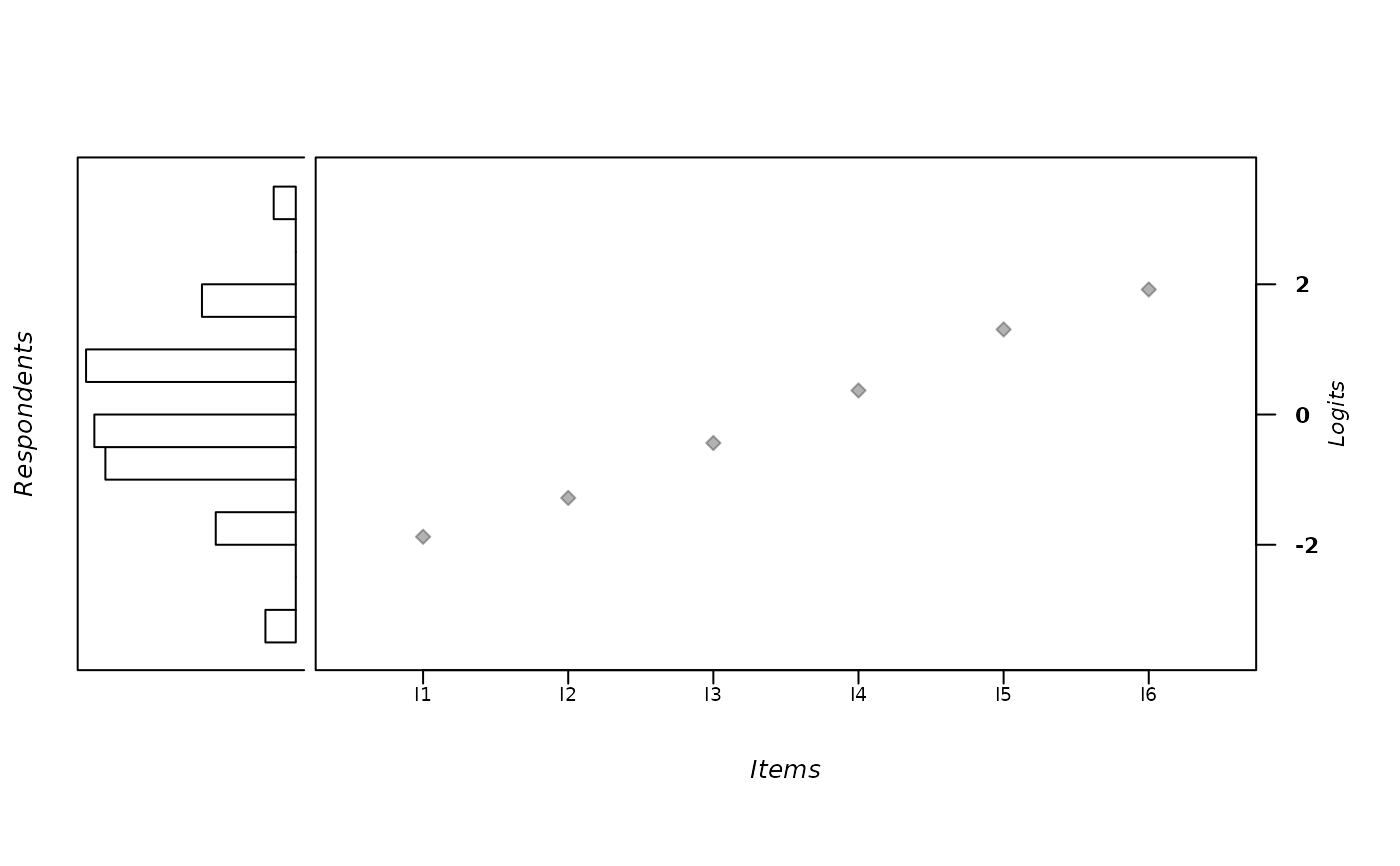
Prepares person estimates and item locations from a fitted model and passes
them to WrightMap::wrightMap(). Person panels may be formed from
variables retained in the fit or supplied as a matrix. Item panels use the
item.groups facility in WrightMap 1.5.
Usage
wright_map(
  fit,
  type = c("thresholds", "locations"),
  person_panels = NULL,
  item_panels = NULL,
  ...
)
Arguments
- fit
A fitted object from
rasch, including explanatory, MFRM and EFRM fits. Comparative-judgement models do not estimate person locations and are not supported.- type
Plot category
"thresholds"or one"locations"estimate per item.- person_panels
Optional person-panel specification. Supply the name of one or more variables retained in
fit$person, a vector or factor of panel memberships with one value per person, or a numeric matrix or data frame whose columns contain the estimates for the panels. Missing estimates are permitted; other non-finite values are not. Panel memberships cannot be missing or blank. For EFRM fits,"groups"uses the fitted person groups.- item_panels
Optional vector or factor assigning each item row to a panel. A named vector must name every fitted item exactly once; an unnamed vector is used in item order. A named list may instead assign every fitted item exactly once to a non-empty panel. Memberships cannot be missing or blank. For EFRM fits, use
"sets","groups", orc("sets", "groups")to arrange the calibrated response columns by item set, person group, or frame. This option requires WrightMap 1.5 or later.- ...
Further arguments passed to
WrightMap::wrightMap(), such asperson.side,item.side,main.title, or graphical settings.
Value
Invisibly, the threshold matrix returned by
WrightMap::wrightMap() when its return.thresholds argument
is true; otherwise NULL.
Details
For partial credit and rating scale models, type = "thresholds"
displays each item's estimated category thresholds, labelled t1,
t2, and so on. A wholly dichotomous scale omits the redundant
t1 labels; in a mixed scale, dichotomous items retain t1 to
align them with the polytomous items. type = "locations" displays
one location per item. In MFRM and EFRM fits, the rows are the calibrated
item-by-facet or item-by-frame response columns.
For EFRM fits, person_panels = "groups" and item_panels =
"sets" use the fitted frame design; both may be specified together.
A single person panel has no heading by default. When several person panels
are requested, their panel labels are printed above the distributions. The
plot has no overall title unless one is supplied through main.title.
The fitted calibration must have converged.
References
Torres Irribarra, D., and Freund, R. (2025). WrightMap: IRT item-person map with ConQuest integration. R package version 1.5.